Products
Singing Bowls
Ancient Sound Healing Tools, Hand-Hammered in Kathmandu
About singing bowls
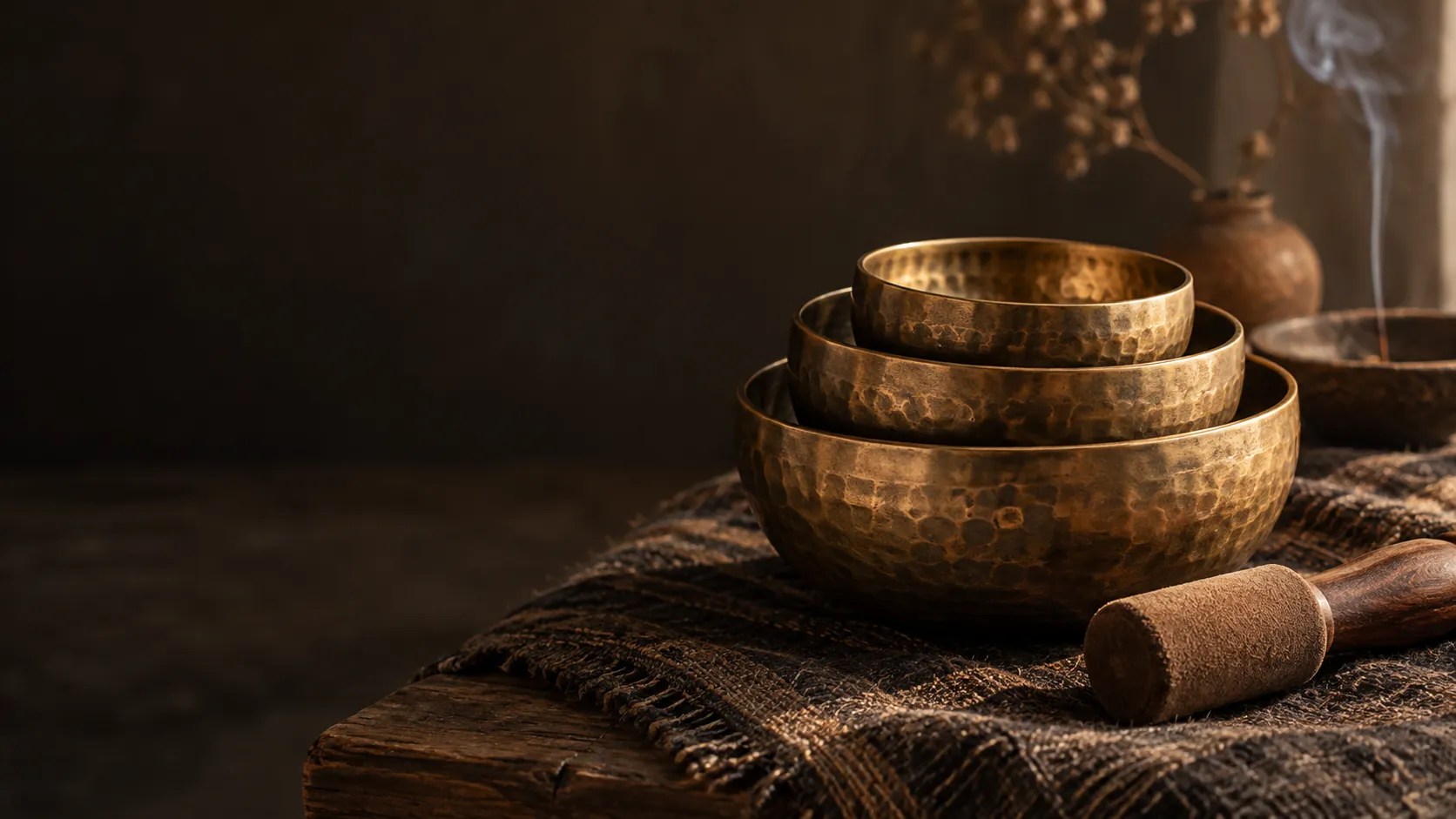
Nepali singing bowls are crafted using techniques passed down through generations of metalworkers in Kathmandu Valley and Patan. Traditional bowls are hand-hammered from a blend of seven metals — gold, silver, mercury, copper, iron, tin, and lead — each corresponding to a celestial body in Buddhist and Hindu cosmology. The hammering process is performed by teams of 3-5 craftsmen working in rhythm, slowly shaping a flat metal disc into a resonant bowl over several hours. The resulting sound is rich, complex, and multilayered — prized by meditation practitioners, sound healers, yoga studios, and therapists worldwide.
How they are made
The process begins with melting and alloying the metals in a clay crucible at over 1,000 degrees Celsius. The molten alloy is poured into flat disc molds. Once cooled, the disc is reheated and a team of smiths hammers it into shape by hand — each bowl requires 2,000-5,000 hammer strikes. After shaping, the bowl is lathed on the inside for smoothness, tuned by careful hammering to achieve the desired fundamental tone and overtones, and finally polished or left with the traditional hammered patina. Hand-hammered bowls produce complex, multi-tonal sounds, while machine-finished bowls offer consistent pitch at lower cost.
Singing Bowls — questions people ask
What is the difference between hand-hammered and machine-made singing bowls?
Hand-hammered bowls are shaped by teams of artisans using thousands of individual hammer strikes, producing complex overtones and a warmer, more layered sound. Machine-made (or 'cast') bowls are poured into molds, producing a consistent but simpler tone. Hand-hammered bowls are preferred by serious practitioners and command higher prices.
Are the bowls really made of seven metals?
Traditional Nepali singing bowls are made with an alloy of seven metals, though the exact proportions vary by workshop and are often closely guarded secrets. The primary metal is always copper (roughly 70-80%), with tin as the secondary metal. Gold, silver, and other trace metals are added in small amounts. We can provide metal composition certificates on request.
Can I order bowls tuned to specific notes?
Yes, we offer chakra-tuned sets where each bowl is tuned to correspond to one of the seven chakras (C, D, E, F, G, A, B notes). Custom tuning requires additional lead time (6-8 weeks) and a higher per-unit cost due to the precision involved.
How do I choose the right size singing bowl?
Smaller bowls (4-6 inches) produce higher-pitched tones and are ideal for upper chakra work and personal meditation. Medium bowls (7-9 inches) offer balanced sound and are the most popular. Large bowls (10-16 inches) produce deep, grounding tones suited for sound baths and therapy sessions.
Do you ship singing bowls internationally?
Yes, we ship worldwide. Bowls are individually wrapped in bubble wrap and packed in reinforced cartons. We include strikers and cushions with each bowl. Shipping is typically via air freight for samples and sea freight for wholesale orders to keep costs manageable.
Buying by the carton rather than the piece? Talk to us about volume →